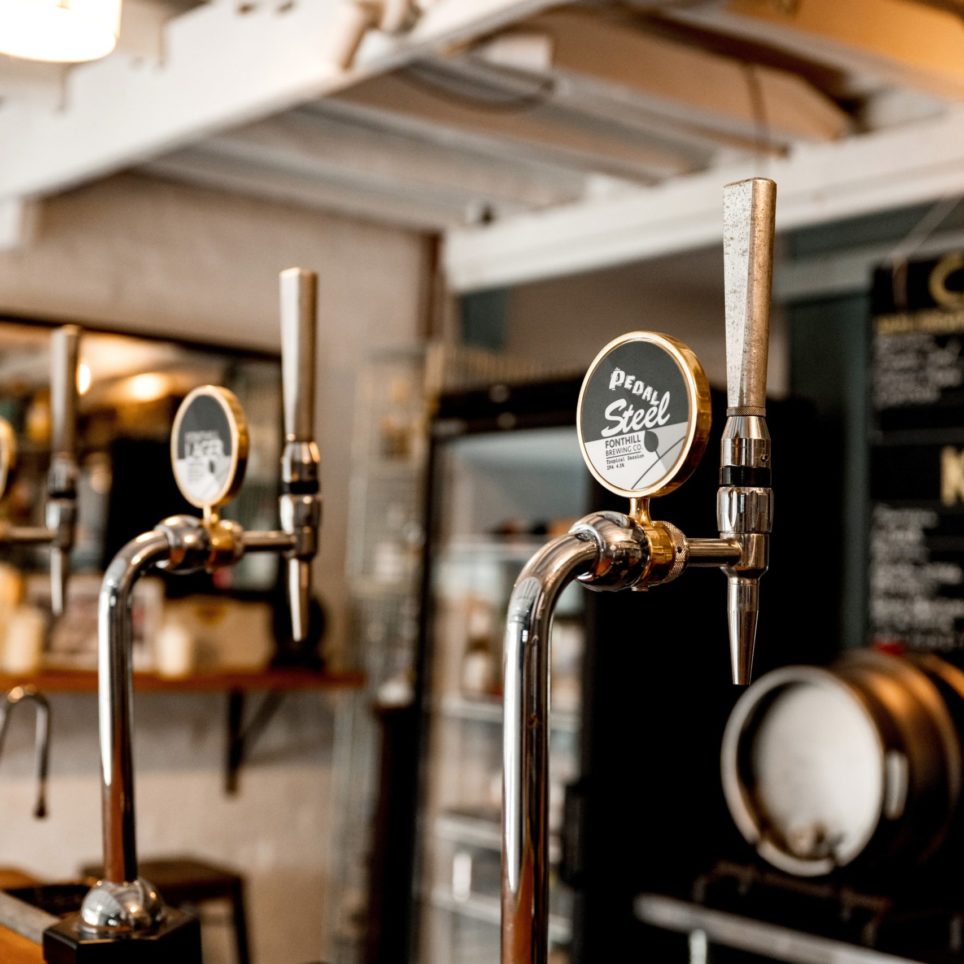
Green hop beer is a seasonal beer brewed with freshly harvested, undried hops rather than the dried or pelleted hops brewers normally use. For a brewery in Kent, green hop beer has an added significance. Our corner of Britain has a long history of hop growing, and the annual harvest still creates an exciting brief period when brewers like us can take fresh hops from the bine and turn them into a very special kind of beer!
To qualify as a green hop beer, they must be Kent hops, and they have to be in the kettle within 12 hours of picking. – Paul, Fonthill Brewing Co.
At Fonthill Brewing Co. in Tunbridge Wells, that means working quickly with Kent-grown hops during harvest season. Over the last few years, we’ve produced green hop beers including Knut, which won Best Green Hop Beer of the Festival at the 2024 Spa Valley Railway Real Ale & Cider Festival, and Input the Output, a 2025 green hop pale, using Challenger hops from Hukins Hops farm in Kent.
The hop variety, harvest conditions, timing and recipe all influence what ends up in your glass, and this year we’re very excited to introduce you to Fuggling Moves (beginner), our 4.3% Green Hopped Best Bitter, brewed with Fuggles hop variety from Hukins Hops.
What is green hop beer?
Green hop beer is beer brewed with hops that have been picked from the bine and used fresh, without first going through the normal drying process.
Most hops used in brewing are dried soon after harvest, a process which reduces their moisture content and makes them stable enough to package, transport and store. Brewers can then use those hops throughout the year.
But green hops take a different route.
Instead of being dried and stored, they travel from the hop garden to the brewery while they are still fresh, and into the kettle within 12 hours of picking.
You may also come across the terms “fresh hop beer” and “wet hop beer”. These are often used to describe closely related brewing approaches, but here in Kent, “green hop beer” has a particularly strong connection with the annual hop harvest.
Green hops vs dried hops
| Green hops | Dried hops |
| Used fresh after picking | Dried soon after harvest |
| Very high moisture content | Low moisture content |
| Difficult to store for long periods | Designed for storage |
| Used during a short harvest window | Available throughout the year |
| Can contribute fresh, green and herbal characteristics | Can provide a wide range of bitterness, flavour and aroma |
Why does timing matter so much?
Fresh hops are perishable, so once they’ve been picked, the clock starts ticking.
A hop grower normally dries the harvested cones in an oast to stabilise them, but for a green hop beer, that step is deliberately skipped. The hops remain fresh and must reach the brewery quickly.
The exact target varies between brewers and green hop programmes, but Kent Green Hop Beer has strict criterion: the hops must be Kent-grown and used fresh and undried within 12 hours of picking.
That speed is part of the appeal. A green hop beer captures a particular harvest, from a particular place, at a particular point in the season. It tells an entire story in one sip.
What do green hops taste like?
There is no single “green hop flavour”.
The result depends on the hop variety, growing conditions, harvest timing, quantity used and the way the brewer uses the hops, because the recipe, and therefore the style the brewer is aiming for, all make a huge difference.
What green hops can contribute are fresh, grassy, herbal, floral, earthy, spicy, fruity or hedgerow-like notes. Some green hop beers also have a soft, oily or slick texture because of the oils and large quantity of fresh plant material involved.
The Brewers Association describes fresh hop beers as potentially showing green grass, fresh-mown hay and other fresh-hop characteristics, and CAMRA highlights fresh, oily and herbal qualities, while noting that flavour varies between hop varieties.
Challenger, for example, is a traditional British hop with a broad range of uses. Hukins Hops described Challenger as having spicy, cedar and green tea aromas alongside sweet floral notes, with a rounded bitterness and crisp, fruity character when used later in the brewing process.
Why is Kent so closely associated with green hop beer?
Kent has been one of Britain’s major hop-growing areas for centuries. Its hop gardens, oast houses and harvest traditions are such an important part of the county’s agricultural and brewing heritage.
But the connection goes beyond history. Fresh Kent hops can move from local hop gardens to nearby breweries quickly, which is particularly useful when the brewing window is measured in hours rather than weeks.
For us, brewing a green hop beer in Tunbridge Wells means being able to work with a crop grown in the county around us. It gives us a direct link between the hop garden and the pint. We’re lucky enough to be able to serve our craft beer, at our pub in Tunbridge Wells, just a few steps away from where it was brewed. The “farm-to-tun” ethos is at the heart of what we do.
Learn more about Fonthill Brewing Co.
From hop garden to brewery
The process begins at the hop farm. The grower harvests the cones when they’re ready, and the brewery collects and delivers them to the kettle quickly enough to preserve their fresh character.
Hukins has been growing hops in Kent for more than a century, and our last two green hopped beers have also been made using Hukins Hops.
For our last two beers, Paul collected fresh Challenger hops and got them from the bine to the kettle in about three hours.
From there, the beer followed the normal stages of brewing, fermentation and conditioning, with the beer spending around seven days in the fermenter before moving into casks for a further two weeks of conditioning.
This year, we’re using Fuggles hops (also from Hukins Hops in Kent) to create something a little different: a green hopped Best Bitter.
Fonthill’s 2026 green hop beer: Fuggling Moves (beginner)
Hop variety: Fuggle
Supplier: Hukins Hops
ABV: 4.3%
First pour: Start of October 2026
In order to be as fresh as possible, we have refined our brew day process over the years. We get the mash in first thing and once the wort is in the kettle and steadily warming up to boil, I head out in the van to Hukins Hops in Tenterden. It’s about a two hour round trip with a bit of time to chat with Glen and take some pictures at the farm, so the kettle needs careful monitoring at brew HQ to make sure we don’t start evaporating off.
Being a subtle hop we decided to add the Fuggles late in the boil in an effort to catch as much aroma as possible, so 30% goes in with 10 minutes left of boil, and the the rest goes into the mash tun which we use as a hop back. We then cool the wort to ~80 degrees before recirculating it through the hops and back to the kettle for 20 minutes before we transfer to the FV.
As we’re using freshly picked cones, we do lose some liquid to absorption so we have to take this into account in planning the mash and liquor calculations. Even so the yield is always lower than with a dried product so it really does become a rare one off brew.
Why use Fuggle hops for a green hop beer?
Fuggle is one of the classic British hop varieties that’s been used in traditional British ales for generations, and is associated with earthy, herbal, woody and mild spicy characteristics. Why did we use it? Paul puts it best…
We chose to use Fuggles this year quite simply as that was what was being picked on brew day! Given changeable weather around harvest time, we often don’t know until the day what variety we’ll be collecting… Indeed, a few years back, we designed the brew, name, and artwork based on what we thought we were going to get, only to be thwarted by two days of heavy rain! We ended up instead with something different, though the result was Knut, our award winning green hop beer, so a happy accident some might say.
In the past we have tended to brew our green hops beers using a similar malt base to Good Morning Captain to create a pale ale. As we were using Fuggles this year, we decided to aim for a Best Bitter. We use dried Fuggles in Fonthill Best, as being quite a delicate variety with low alpha acid composition, they sit well in a more malt forward style. – Paul, Head Brewer at Fonthill Brewing Co.
How is green hop beer different from a normal Best Bitter?
Fuggling Moves is still a Best Bitter; the green hop addition doesn’t turn the beer into an entirely different style or category of beer.
The difference is in the hops and when we use them.
The fresh hops we’ve used give the beer a different sensory profile. Fresh green, herbal, earthy and plant-like characteristics might be more noticeable, but the underlying Best Bitter gives those flavours a familiar structure.
How should you taste a green hop beer?
You don’t need specialist beer knowledge to enjoy a green hopped beer.
Start by looking at the beer. Note its colour and clarity, then smell it before taking a sip. Then look for fresh hop characteristics rather than trying to identify a single exact flavour. You might notice grass, herbs, flowers, spice, citrus, fresh fruit or an earthy character.
Take a sip and consider the texture as well as the flavour. Some fresh-hop beers have a slightly oily or slick quality.
Finally, notice how the bitterness develops and how long the hop character remains.
Our earlier green hop beers (if you’ve tried them) provide a useful example of how much the interpretation can change from year to year. Knut and Input the Output were separate beers, made in different harvest years, but they used the same hop variety.
Why is green hop beer seasonal?
Fresh hops are seasonal crops.
Hop harvest usually takes place around late summer and early autumn, with mid September being an important part of the harvest period. The precise timing depends on the variety, farm and growing conditions, so it’s impossible to give an exact date for each year.
Once the hops have been picked, a brewer has a very limited period in which to use them fresh. That’s why green hop beer tends to appear for a short period each year rather than remaining on a pub bar throughout winter and spring; once it’s gone, it’s gone.
Green hop beer FAQ
Is green hop beer made with green-coloured hops?
Yes, but “green” refers to the fresh, undried state of the hops rather than the colour of the finished beer. The beer itself can range from pale gold to much darker shades depending on the underlying recipe.
What is the difference between green hop and fresh hop beer?
The terms are often used for closely related styles of brewing. Both involve using freshly harvested hops rather than hops that have been dried and stored. “Green hop beer” is particularly associated with the British hop harvest and, in Kent, with beers brewed from freshly harvested Kent hops which reach the kettle within 12 hours from picking.
Does green hop beer taste grassy?
It can. Fresh green, grassy or herbal notes are common, but the flavour depends on the hop variety, harvest and brewing process. Some beers can also show floral, fruity, spicy or earthy characteristics.
How quickly do green hops need to be used?
Some growers recommend using fresh green hops within 24 hours for the best quality, but the Kent Green Hop Beer criteria have traditionally required fresh Kent hops to reach the kettle within 12 hours of picking.
Is green hop beer only brewed in Kent?
Brewers in other hop-growing regions can and do make fresh hop beers. Kent has a particularly strong association with the tradition because of its long history of hop growing and the established Kent Green Hop Beer season.
What is Fuggling Moves?
Fuggling Moves is our 2026 green hop beer at Fonthill Brewing Co. It is a 4.3% Green Hopped Best Bitter made with Fuggle hops from Hukins Hops.
When can I try Fuggling Moves?
Like all green hop beers, Fuggling Moves is a seasonal beer, so availability is limited to the current batch from the first pour until it runs out. Keep an eye on our socials and our newsletter, and we’ll let you know as soon as we’re pouring.
Try the 2026 Fonthill green hop beer
Green hop beer gives you a chance to drink something closely tied to the annual Kent hop harvest. The hops are picked, transported and brewed within a short window, creating a beer that cannot simply be kept on the shelf all year.
Since harvest, the beer had a week of fermentation and is now in cask in our conditioning room, so we’re expecting to have it on at The George some time towards the end of next week, depending on the beers ahead. We will also be moving some down to the Sussex Arms and also to Spa Valley Railway for their beer festival next month. Drinkers will hopefully pick up some slight bitterness and floral notes from the finished product plus a malty backbone as expected in a Best Bitter.
For us, the appeal is particularly local: Fuggle hops from Hukins Hops, a Tunbridge Wells brewery and a beer that reflects the harvest season.
Fuggling Moves is our 4.3% Green Hopped Best Bitter. If you spot it on the bar, give it a try while this year’s batch lasts.
And if you enjoy it, remember that the next green hop beer will be another year’s harvest, another set of conditions and another opportunity for us to see what fresh Kent hops can bring to the brewery.
If you are visiting Tunbridge Wells during green hop season, please remember that availability is limited and changes once the seasonal batch has sold through.
Related Posts
How to Taste & Rate Beer
Beer Tasting Guide from Fonthill Brewing Co.
How to Choose Craft Beer for Your Pub