
Beer tasting isn’t about fancy vocabulary or judging with a stiff clipboard… Well, maybe for some people it CAN be, but it doesn’t have to be.
For us, it’s about taking a few moments to truly notice what’s in your glass, and then notice what it tastes like in your mouth. When you slow down, sip with intention, and learn what creates certain flavours, you begin to understand why you like what you like.
As a craft brewery, we tend to obsess over malt, water chemistry, yeast strains, hop varieties, fermentation temperatures, and every microscopic detail that goes into a pint, and we want you to enjoy every single sip! We’ve created this guide (alongside our beer scorecard) to help you taste more deeply, take notes, and remember the beers that really stick with you.
Whether you’re at our taproom in Tunbridge Wells, one of our pubs, or tasting at home, this guide will teach you how to taste beer properly, and rate it like a brewer.
Use this guide as a reference!
Bookmark this guide, then come back to it whenever you need to. You’ll be tasting beer and rating it like a pro before you know it.
Why Tasting Matters
Beer is surprisingly complex. Every pint is a balance of grain sweetness, hop bitterness, fermentation character, mouthfeel, and aroma. Learning to taste properly helps you to recognise beer styles and their signatures, understand and identify each distinct flavour that you love (and the ones you don’t!), and help you appreciate new styles beyond your usual go-tos.
Slowing down and tasting intentionally is one of the best ways to appreciate the craft and skill behind every brew.
CAMRA’s Framework: The Simple Five
Most beer judging, especially here in the UK, revolves around five core pillars used by CAMRA (Campaign for Real Ale):
| CAMRA Category | What It Means |
| Look/Appearance | Colour, clarity, head retention |
| Aroma | Hop aromas, malt notes, yeast character |
| Flavour | Sweetness, bitterness, balance, finish |
| Mouthfeel | Carbonation, body, texture |
| Overall Impression | Did it work as a beer? And did you enjoy it? |
Nobody expects you to write a formal report when you’re tasting beer for your own enjoyment, but these five points do give you a helpful lens if you want one.
We’ve created the Fonthill Brewery Scorecard to be deliberately simple with a simple star rating and an open text box, so you can leave as much or as little information as you like. You can use CAMRA’s pillars, as well as the guide below, as inspiration for whatever you write in that text box, or your own personal notes (if you’re rating other beers.)
How to taste beer (5 steps)
1. Look: Colour, Clarity, Head
First step, take a moment to appreciate what the beer looks like! Hold your glass to the light.
Notice the colour: straw gold, deep amber, chestnut brown, or jet black.
Look at clarity: is it bright and clear, softly hazy, or intentionally opaque? All can be correct, depending on the style.
Finally, examine the head:
How thick is the foam?
How long does it last?
Does it leave lacing down the glass?
Head retention tells you a lot about the beer’s proteins and carbonation. A beer with tight, persistent foam is usually well-conditioned.
2. Swirl: Wake the Aroma
A gentle swirl releases aromatic compounds, especially hop oils., and it also warms the beer slightly, helping to lift the full “bouquet”.
As the scent rises, take a few moments to notice the different aromas. Unfiltered beers and hop-forward styles usually present a richer aroma.
3. Smell: First Impressions Count
Close your eyes. Breathe in slowly.
What hits you first?
Is the aroma bold, soft, clean, sweet, herbal, malty, fruity?
Some aroma families:
Hop-Driven: notes of citrus peel, passionfruit, resin, pine
Malt-Driven: caramel, toast, biscuit, toffee notes
Yeast-Driven: clove, banana, spice, pepper
If you’re struggling to describe what you smell, compare it to food. Your brain recognises buttered toast and grapefruit far quicker than ‘yeast ester’.
4. TASTE: SWEET, BITTER, SOUR, BALANCE
Take a sip and let it spread over your tongue.
Then think about the following:
Flavour:
What arrives first?
Does anything linger after the swallow?
Is it floral, fruity, roasted, toasty, herbal, sharp, sweet?
Bitterness:
Look out for any bitterness. What’s it like? Is it sharp, punchy, soft, smooth, pithy?
Sweetness:
What about the sweetness? Does it taste like malt caramel? Biscuit? Chocolate? Honey?
Acidity (sourness):
Clean and crisp?
Gently tart?
Lightly citrusy?
Body:
What about the texture of the beer? Does it feel thin or light (watery), medium, or full (creamy/chewy)? Is it light or luxurious?
Light bodied beers have the same texture as skimmed milk, whereas the texture of a full-bodied beer will be more comparable to full fat milk.
Carbonation:
Soft and rounded?
Sparkling or spritzy?
Bold and lively?
And importantly: does it feel balanced? Great beer isn’t all sweetness or bitterness, it’s harmony.
5. Finish: Aftertaste, Mouthfeel & Memory
After swallowing that first delicious sip, focus on the end. What’s left?
Ask yourself:
Clean finish or sticky hop resin?
Dry or slightly sweet?
Smoky, earthy, warming?
Does the flavour fade or intensify?
Most importantly, your personal impression: do you want another sip? Would you order a second pint?
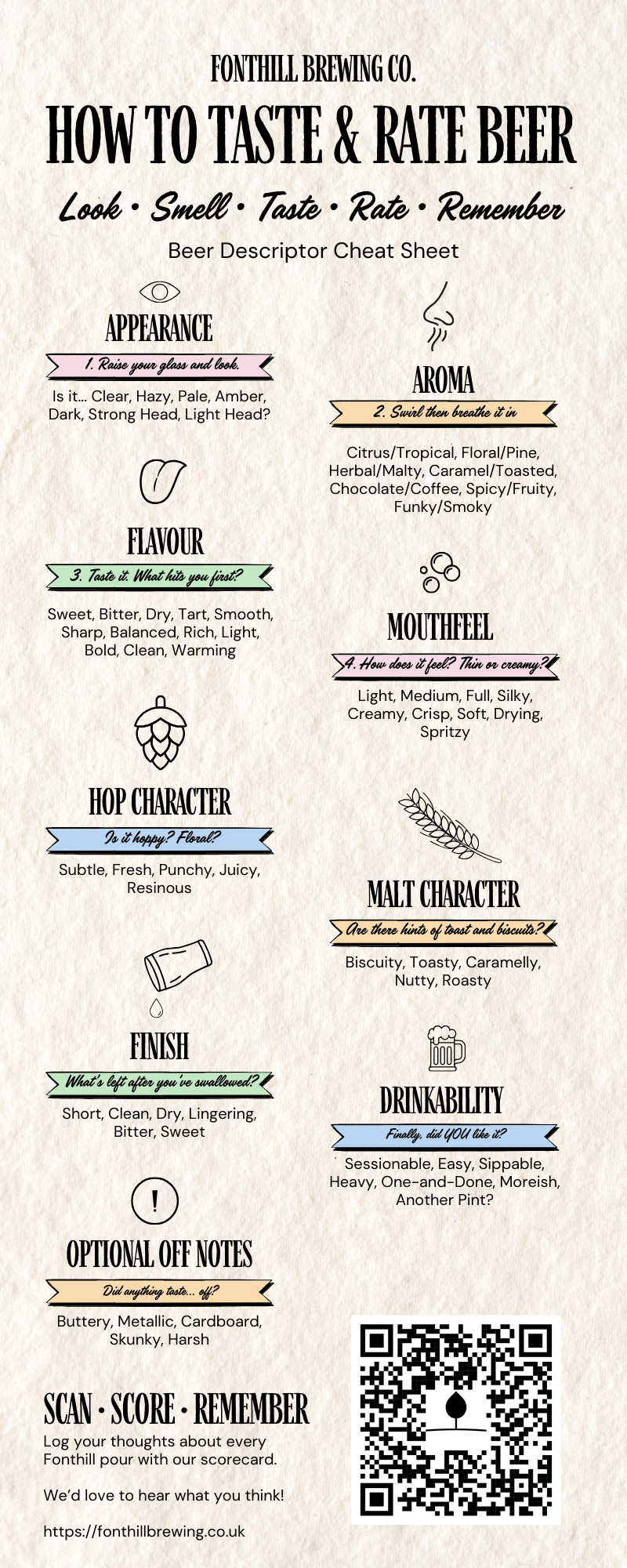
This is the moment to pick up your scorecard (or app, or diary, or clay tablet…) and note down what you notice. If you’re stuck for words, check out our beer-tasting descriptor cheat sheet below.
Supply:
- 3-5 beers
- Identical glasses
- A few friends.
Beer Tasting Cheat Sheet
How to Use the Fonthill Beer Scorecard
Whether you’re sitting with a pint of Fonthill beer at The Philanthropist or sampling one of our seasonal brews at the George, or indeed another pub, log in to the Fonthill brewery scorecard and take a moment to leave a star-rating and a few notes. It takes seconds, and the more you taste, the more you’ll notice.
Once you’ve left your notes, you can close the webpage and come back to it any time you like. You’ll be able to add additional notes, or look back at your notes to remember which beer you liked best.
Plus, we genuinely love seeing what people pick up in our beers. It helps us make better decisions brew-to-brew.
So every logged rating makes you a better taster, and helps us keep improving.
Tasting Tips from Our Brewer
- Taste in natural light if possible
- Don’t drink ice-cold. Cold dulls flavour
- Use plain water to reset your palate
- Always look, swirl and smell first
- Leave gaps between strong or high-ABV beers
- Drink from glass, not can. Aroma matters
Common Flavour Notes (and What Causes Them)
| Flavour note | What it’s usually from |
| Citrus & Pine | Hop oils (especially US/NZ varietals) |
| Grapefruit & Mango | Dry-hopping with modern aromatic hops |
| Caramel & Biscuit | Crystal and Vienna malts |
| Coffee & Cocoa | Dark roasted malts (chocolate, black, roasted) |
| Bread & Toast | Base malts, or specific mash profiles |
| Banana & Clove | Ale yeast fermentation esters |
| Stone Fruit | Northeastern hop varietals or English yeast |
| Dark Fruit | Specialty malts and oxidation in high-ABV ales |
| Herbal & Floral | Noble/European hops |
| Pepper & Spice | Certain ale yeasts, saison strains |
Tasting Styles: Cask vs Keg vs Bottle
The same beer will taste different depending on whether it’s poured from keg, bottle or can.
Cask Ales
Cask Ales tend to have softer carbonation and a gentler mouthfeel. Flavours will bloom as the beer warms in the glass.
Keg
Crisper, colder, and excellent for hop clarity. Ideal for punchy IPAs, lagers, and modern pale ales. Keg’s are usually fizzier.
Bottle/Can
Bottles and cans are great because they are portable and consistent, but, let’s face it, they are rarely as fresh as beer poured metres from the brewery.
In the end, fresh beer, served properly and poured through clean lines, will always taste better. We only serve our beers straight from Keg and Cask, but if you’re tasting other beers, try scoring them across different formats. How does a canned beer taste compared to when it’s poured fresh?
Interested in learning more? You may enjoy these guides:
- Ale vs Lager: What’s the Difference
- Cask vs Keg: What’s the Difference
Advanced: Spot Flaws Like a Pro
Flaws don’t always mean bad brewing. Actually, some are style-specific. But if you’re curious about fault-finding, here are the common notes to look out for.
- Diacetyl: buttery, toffee notes
- Oxidation: wet cardboard, stale bread
- Light-Strike: “skunky”, from beer exposed to light
- Astringency: harsh bitterness or drying tannins
But, remember: context matters. Some ales embrace mild ester or phenolic spice. Your tasting notes help track what you detect over time.
How to Run a Mini Beer Tasting
For some extra fun, gather a group of friends and run a min-beer tasting session.
- 1. Pick 3–5 beers
- 2. Use the same glass shape for each (Beer glass types)
- 3. Taste pale to dark
- 4. Swirl, smell, sip
- 5. Write your notes and ratings (or use the Fonthill Scorecard if you’re trying our beers!)
- 6. Compare notes and results
A perfect practice set
- A Lager (like Fonthill Lager)
- A Pale Ale (like Good Morning Captain)
- An IPA (like Flame On!)*
- A Seasonal special (like Where’s Me Jumper)
*When it comes to IPAs, there are as many different sub-styles as there are tastes! Learn more about IPAs in The George’s guide to IPA beer styles.
Want to Practise? Come Taste Our Beer
The best way to learn is simple: drink thoughtfully.
Visit The Philanthropist or one of our pubs in Tunbridge Wells and ask the team for guidance. Better yet, pop over to The George and ask for a tasting flight. Grab some food. Taste Fonthill beer made fresh on-site, compare results with friends, and see which beers you love most.
Turn a simple pint into a full experience!