Let’s cut to the chase. A nitro stout is a stout served with nitrogen as part of its carbonation and dispense. Nitrogen produces much smaller bubbles than carbon dioxide, giving the beer a softer mouthfeel and a dense, creamy head that’s simply unlike other beer types.
If you’ve ever stood at the bar and watched it pour: a dark beer hits the glass, the tap runs almost silently, and a strange cloud of bubbles seems to tumble through the pint. The beer looks as though it is boiling for a few seconds before smoothly settling beneath a thick, creamy and luxurious head.
Then you take a sip and notice that it feels different from an ordinary stout. It’s soft, smooth and almost velvety, with far less of the familiar fizz you get from most beers.
So, what is nitro stout?
A nitro stout is a stout served with nitrogen as part of its carbonation and dispense. Nitrogen produces much smaller bubbles than carbon dioxide, giving the beer a softer mouthfeel and a dense, creamy head.
The effect has become closely associated with Irish-style dry stouts, but independent breweries across the UK are now putting their own spin on nitrogenated dark beers. Fonthill Brewing Co. is one of them.
Our 4.2% Godspeed is a small-batch nitro stout hand-crafted at our brewery in Kent, with coffee, chocolate and molasses flavours alongside dark fruit, vanilla and a gentle hint of smokiness.
But what actually happens inside the glass?
What does “nitro” mean in beer?
“Nitro” simply refers to nitrogen.
Most beer is carbonated primarily with carbon dioxide, or CO2. It’s the gas responsible for the familiar sparkle and prickly sensation you associate with fizzy drinks and many beers. But nitrogen behaves differently.
It’s less soluble in beer than carbon dioxide, and when it’s released through a suitable dispense system it produces very, very small bubbles compared to CO2. Those tiny bubbles give nitrogenated beer its characteristic smooth texture and appearance.
This is why two otherwise similar stouts can feel surprisingly different in the glass.
A traditionally carbonated stout can have a more noticeable carbonation and a sharper, more lively sensation on the tongue, whereas a nitro stout tends to feel softer and rounder.
The beer itself hasn’t necessarily been made with completely different ingredients. The major difference can instead come from what happens after fermentation, during conditioning, kegging and dispense.
The term “nitro” describes the way the beer is conditioned or served; it’s not a separate family of ingredients. In other words, a nitro stout is a stout, but not every stout is a nitro stout.
What is the difference between stout and nitro stout?
Stout is a broad beer style, whereas a nitro stout is a way of presenting a stout that changes its carbonation, texture and appearance.
A conventional stout can be carbonated with CO2 and served through a normal beer dispense system. A nitro stout uses nitrogen, generally alongside some CO2, and requires the appropriate dispense equipment to get the intended result.
The underlying stout can still have all the characteristics you expect from a dark beer: roasted malt, coffee, chocolate, dark fruit, caramel, toast or even a gentle smokiness.
What nitrogen changes is the experience of drinking it.
The smaller bubbles create a smoother texture, while the way nitrogen behaves when it leaves the keg produces the famous cascading effect. This is why “nitro” should not be confused with a particular flavour.
Nitrogen doesn’t suddenly turn a stout into a coffee stout, make it sweeter, or smokier, or add cream to the beer. The recipe still matters! The malt, yeast, hops, fermentation and conditioning all contribute to the flavour.
But nitrogen changes the way those flavours arrive in your glass, and the experience in your mouth.
Why does nitro stout have a creamy head?
A thick creamy head is one of the most recognisable characteristics of a nitro stout.
The nitrogen bubbles are much smaller than typical CO2 bubbles. That helps create a dense, persistent foam rather than the larger, more sparkling bubbles you might see on other beers.
The result is the thick, creamy looking head associated with a classic nitro stout. But despite the word “creamy”, there doesn’t need to be any cream or dairy in the beer at all.
The texture comes from the beer’s composition, carbonation and dispense. A nitro stout can be completely dairy-free and still have that remarkably creamy mouthfeel.
This is one reason nitrogenated stouts have become so distinctive. You’ll easily recognise one before you’ve even tasted it.
What causes the cascade effect in nitro stout?
The cascade is the bit that catches people’s attention.
Next time you’re at the bar, watch a freshly poured nitro stout and you’ll see tiny bubbles moving through the beer. Some appear to travel down the sides of the glass while the liquid moves upwards through the centre.
Eventually, the movement slows and the beer settles into its familiar dark appearance with a thick head sitting on top.
The effect happens because of the behaviour of the nitrogen as the beer leaves the dispense system and the pressure changes. It’s also one of the reasons a nitro stout is such a good pub beer.
There’s a visible moment between ordering the pint and drinking it, where you can see something happening in the glass rather than simply receiving a dark beer with a head on top.
Does nitrogen change the taste of stout?
It can change how you perceive the flavour, even if the underlying ingredients haven’t changed.
Carbonation affects the way beer feels on the palate. While a more highly carbonated beer can feel sharper and more lively (think lager), the softer texture of a nitro beer can make the beer seem rounder and smoother.
That doesn’t mean nitrogen makes every stout taste sweet.
A dry stout can still taste dry when served on nitrogen, roast character can still be bitter, and coffee and dark chocolate notes can still be prominent. What changes is the delivery.
This is particularly useful with dark beers; roasted malt flavours can be quite assertive, so a softer mouthfeel can make those flavours feel more integrated and approachable.
Why did Fonthill brew a nitro stout?
So why did Fonthill decide to brew a nitro stout in the first place? We asked our head brewer, Paul:
We wanted to have something different in our stable of keg beers outside of the lager and craft options we have been known for up to now. The acquisition of another fermenter gave us the opportunity to try something out without losing valuable tank space for other brews.
With the increased popularity of recognised brands of nitro stout over the past few years we thought it was time to have a go ourselves.
The result was Godspeed, a 4.2% nitro stout designed to bring something different to the bar.
What does Fonthill Godspeed taste like?
Godspeed is Fonthill Brewing Co.’s 4.2% nitro stout, brewed at our small-batch brewery in Kent.
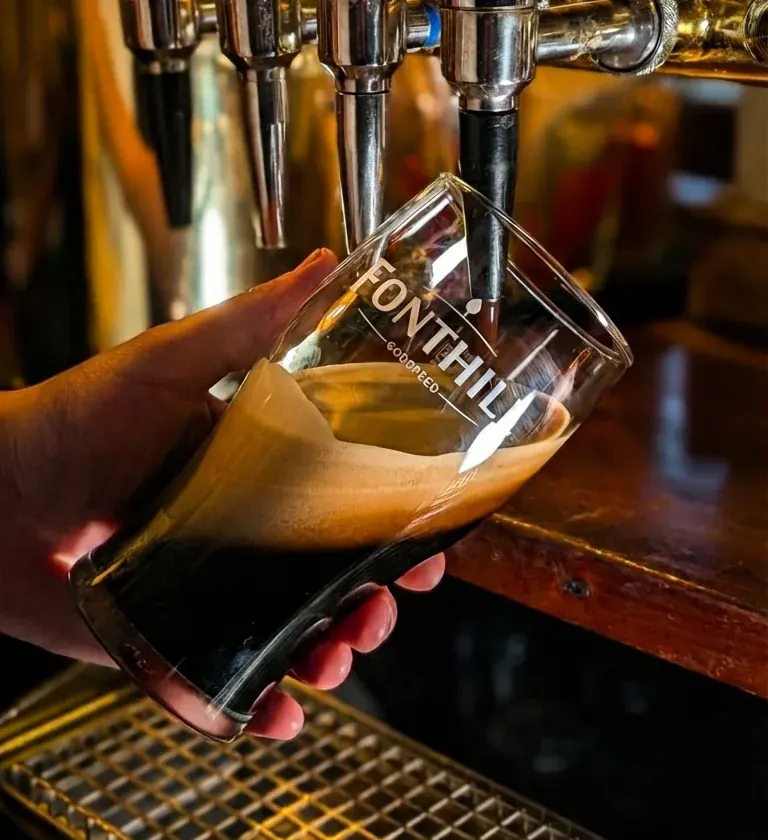
It’s dark, smooth and full-bodied without being a heavyweight beer, with notes of coffee, chocolate and molasses, with dark fruit, vanilla and a gentle hint of smokiness.
That combination makes it a good example of why nitro and stout work so well together.
The roasted character gives you the familiar depth you expect from a dark beer, and the nitrogen dispense then gives the pint a softer, smoother texture.
And at 4.2% ABV, Godspeed sits comfortably in the sessionable end of the stout spectrum, which means our nitro stout doesn’t have to be a special-occasion beer. A well-made 4%ish dark beer can work as a regular pint, particularly when it has enough flavour to stand apart from lighter beers without becoming something you only order once.
Why do breweries put stout on nitro?
Nitrogen can make a dark beer visually distinctive, and the texture gives the beer a point of difference on a crowded bar.
Walk into a pub with ten taps and there might be several pale ales, IPAs and lagers competing for attention, whereas a properly poured nitro stout looks completely different.
The cascade catches the eye. The dense head looks different. The beer feels different when you drink it.
For the pub, that creates an opportunity to give a customer another reason to try something outside their usual order.
For the brewery, it provides another way to express the same basic idea: make a beer that people remember.
There’s evidence that the format is not limited to the biggest established stout brands. CAMRA has highlighted the success of independent breweries producing their own nitrogenated beers, including modern nitro porters and stouts that have moved from seasonal experiments into regular sellers.
Is nitro stout only for Guinness drinkers?
Absolutely not.
Guinness has played an enormous role in making nitrogenated beer familiar to British drinkers, but the technique is now used by independent breweries producing beers with very different recipes and personalities.
Remember, “nitro” tells you something about the dispense and mouthfeel, but not everything about the beer.
One nitro stout might be dry and roasty; another might lean towards chocolate and caramel; another might be lighter and more sessionable. You can even find nitrogenated porters and pale beers.
If you like Guinness, there’s a good chance you will enjoy exploring other nitro beers. If you have never particularly liked Guinness, it’s still worth trying a well-made independent nitro stout before deciding that the whole category is not for you.
Godspeed was brewed with that wider appeal in mind.
It has the dark malt character you’d expect from a stout, but the combination of flavour and nitrogen gives it a softer, more rounded drinking experience.
How should you pour a nitro stout?
Getting the beer into the keg is only part of the process. Serving a nitro stout correctly requires the right gas mix and dispense equipment.
As Fonthill head brewer Paul explains:
“The brew process is the same as with any other cask or keg beer but the difference comes in the introduction of a higher level of nitrogen at the carbonation phase. Nitrogen is less soluble in beer which means that at pour we see the characteristic cascade in the beer, and it delivers a smoother, creamier mouthfeel that people associate with the style along with a more persistent and dense head.”
“To achieve this in a pub it is crucial that nitro stouts are on the correct gas mix of 70% nitrogen to 30% CO2 and poured though either a specific nitro tap or, more commonly, though a font with a restrictor plate in the nozzle. This enables the dissolved gas to come out of solution and form very small bubbles, unlike the larger ‘fizz’ you may expect to see in a lager glass.”
The glass should be clean and suitable for the beer. The pour itself needs to create enough turbulence for the nitrogen to release and form the characteristic head.
Different breweries and dispense setups can have slightly different
recommendations, so the brewery’s serving instructions should always take priority.
And then comes the important bit: wait.
The beer needs time to settle. The cascade is part of the process, not something that means the pint has gone wrong.
CAMRA has also discussed the importance of pouring technique, including the use of a two-part pour to control the appearance and texture of the foam.
Paul explains why the beer is commonly given time to settle:
“This is also why beers of the style are commonly two or three part pours to enable the nitrogen to build that layer below the head as it sits in the glass.”
What does a pub need to serve nitro stout?
If you’re putting a nitro stout on your bar, the dispense setup is worth getting right. The beer’s characteristic appearance and mouthfeel depend on it.
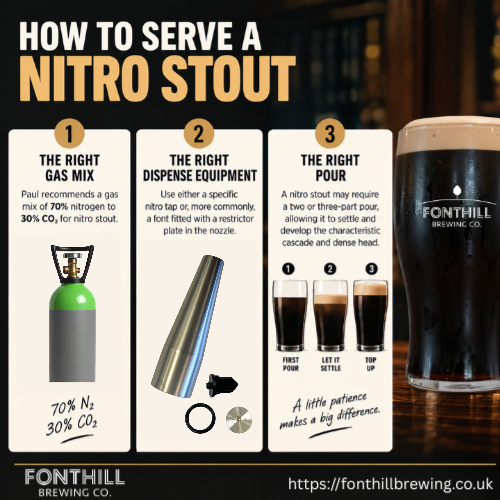
The right gas mix
Paul recommends a gas mix of 70% nitrogen to 30% CO2 for nitro
stout.
The right dispense equipment
A nitro stout should be poured through either a specific nitro tap or, more commonly, a font fitted with a restrictor plate in the nozzle.
The right pour
The beer may require a two or three-part pour, allowing it to settle and develop the characteristic cascade and dense head.
For pubs, getting these details right can make a noticeable difference to the finished pint. If you’re considering adding an independent nitro stout to your keg range, we’d be happy to talk you through what’s needed to serve Godspeed properly.
Does nitro stout have less carbonation?
It can feel less carbonated because nitrogen produces a different texture from a beer carbonated primarily with CO2, but that doesn’t mean the beer contains no CO2.
Many nitro beers use a mixture of nitrogen and carbon dioxide, with the balance and dispense method depending on the beer and the system being used.
The important distinction for the drinker is the result: less of the familiar sharp fizzy sensation and more of the soft, fine-bubbled texture associated with nitrogenated beer.
Why does nitro stout look so different when poured?
There are really three stages to the visual experience of nitro stouts:
First, the beer leaves the tap and the nitrogen begins to come out of solution.
Then you get the cascade, with the tiny bubbles moving through the beer.
Finally, the beer settles and the bubbles form a dense head.
The result is particularly striking with a very dark stout because the contrast between the black or deep ruby beer and pale foam makes the movement easy to see.
It’s one of those rare beer characteristics that works equally well for someone who knows a lot about brewing and someone who simply thinks, “that looks beautiful.”
Is nitro stout a different beer style?
Nitro stout isn’t its own distinct beer style.
“Stout” describes the beer. “Nitro” describes the way the beer is conditioned and dispensed.
There are different styles and interpretations of stout, from dry Irish stout through to sweeter milk stouts, imperial stouts and pastry-inspired modern versions. Any of these could potentially be served with nitrogen, although the result and suitability would depend on the recipe and dispense system.
That is why it is more useful to think of nitro as a treatment or presentation of beer rather than a completely separate beer style.
Why is nitro stout becoming popular with independent breweries?
The renewed interest is interesting because nitrogenated beer has traditionally been associated with a small number of very large brands.
CAMRA has reported growing interest in nitrogenated beers from independent breweries, including modern interpretations of stout and porter. Its reporting on the category also points to younger drinkers showing interest in nitrogenated dark beers, alongside the established popularity of Guinness and Murphy’s.
For smaller breweries, there’s an obvious attraction.
Nitro gives a familiar style a different identity. It creates something that looks distinctive on the bar, gives the customer an experience as well as a drink, and offers pubs another reason to put a dark beer on draught.
For Fonthill, it also fits with the way we think about beer.
We brew in small batches at our brewery in Tunbridge Wells and supply pubs directly with our cask and keg beers. Godspeed gives us a dark beer that can sit confidently alongside our pale ales, other keg and cask beers rather than simply filling another stout slot.
What makes Godspeed a nitro stout?
Godspeed is a 4.2% stout designed to be served on nitro.
The beer brings the dark malt flavours, including coffee, chocolate and molasses, with dark fruit, vanilla and a gentle smoky note. Nitrogen then contributes the soft texture and dense head that give the beer its characteristic finish.
The combination is what makes the pint.
If you’ve only experienced stout in its more familiar forms, Godspeed is a good example of how much difference dispense can make.
Where can you try Godspeed?
Godspeed is brewed at Fonthill Brewing Co. in Tunbridge Wells and is available at our pubs in Tunbridge Wells, including The George and The Sussex Arms.
If you’re a pub, bar or restaurant looking to put Godspeed on your taps, we supply casks and keg directly to trade customers in South East England and beyond.
For drinkers, the easiest way to help a small brewery grow is remarkably simple: ask for the beer by name.
If you enjoy Godspeed, tell the pub. If they don’t have it, ask whether they can get Fonthill Brewery beer.
That tells the pub there’s demand, and it gives an independent brewery a chance to earn another line.
Nitro stout FAQ
What is nitro stout?
Nitro stout is stout served using nitrogen as part of its carbonation and dispense. Nitrogen creates smaller bubbles than carbon dioxide, producing a softer mouthfeel and dense, creamy head.
What makes a stout a nitro stout?
The key difference is how the beer is conditioned and dispensed. A nitro stout is served using nitrogen, usually alongside some carbon dioxide, through an appropriate dispense system.
Does nitro stout contain nitrogen?
Yes. Nitrogen is used as part of the carbonation and dispense process. It is not normally added during fermentation.
Does nitro stout taste different?
It can. Nitrogen changes the beer’s texture and how carbonation is perceived, giving the stout a softer, smoother mouthfeel. The flavour still comes primarily from the recipe, fermentation and ingredients.
Is nitro stout creamy?
Nitro stout often has a creamy texture and dense foam head, but that does not mean it contains cream or dairy. The effect comes from the small nitrogen bubbles and the way the beer is dispensed.
Is nitro stout sweeter than normal stout?
Not necessarily. Nitrogen can make a beer seem rounder and less sharp, which some people perceive as sweeter, but nitrogen itself does not add sweetness.
Why does nitro stout cascade?
The cascade happens as nitrogen comes out of solution after the beer leaves the dispense system. The tiny bubbles create the characteristic movement through the glass before the beer settles.
Can any stout be served on nitro?
Potentially, but the recipe and dispense system both matter. Nitro works particularly well with many dry and sessionable stouts, although nitrogenated versions of other dark beers and even some pale beers exist.
How should you pour nitro stout?
Follow the brewery’s serving instructions and use the correct dispense equipment. Nitro beer is generally poured more firmly than a conventionally carbonated beer, allowing the nitrogen to release and form the characteristic head.
Is Godspeed a nitro stout?
Yes. Godspeed is Fonthill Brewing Co.’s 4.2% nitro stout, brewed in Tunbridge Wells. It has flavours of coffee, chocolate and molasses, with dark fruit, vanilla and a gentle smoky character.
Fancy trying a pint?
If you are a drinker, look out for Godspeed on draught and ask your local pub if they can get it.
If you’re a pub, bar or restaurant looking for an independent nitro stout for your keg range, talk to Fonthill Brewing Co. We brew in small batches from our brewery in Kent and deliver to pubs and venues directly. Talk to us today about stocking Godspeed.